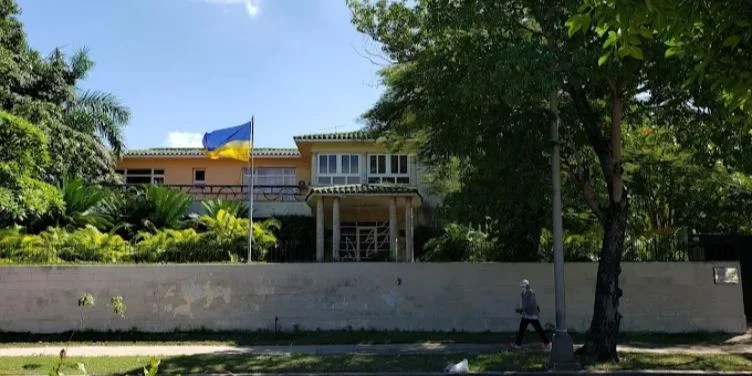
MIAMI, United States – Ukraine has announced that it will close its embassy in Cuba and downgrade the level of its diplomatic relations with Havana, according to a statement posted Wednesday by the European country’s Foreign Minister, Andriy Sybiha, on X.
“We recall the Cuban president’s wish for ‘success’ to Putin in his war of aggression against Ukraine. We heard it clearly. This year, we decided to close our embassy in Havana and downgrade the level of our diplomatic relations,” wrote the Ukrainian foreign minister.
The announcement came just hours after the UN General Assembly approved—for the 33rd consecutive year—a resolution calling for an end to the U.S. embargo on Cuba, with 165 votes in favor, seven against, and 12 abstentions.
For the first time, Ukraine voted against the resolution. “Our vote was not aimed at the Cuban people — we respect their right to live in prosperity — but against the inaction of Havana’s authorities in the face of the mass recruitment of its citizens by the Russian occupation army,” Sybiha said.
He added that “Havana’s refusal to stop the mass deployment of its nationals in Russia’s war against Ukraine constitutes complicity in the aggression and must be condemned in the strongest terms.”
Sybiha did not provide details about the operational timeline for the closure or any temporary consular arrangements. As of the time of publication, there had been no official statement from Cuba’s Ministry of Foreign Affairs (MINREX) regarding Ukraine’s announcement. According to the head of Kyiv’s diplomatic service, the measure will be implemented “this year.”
Cuba’s embassy in Kyiv has been “temporarily closed since March 14, 2022,” according to official information from the Cuban government itself.
Havana aligned with Moscow
On May 9, 2024, during a meeting at the Kremlin, Miguel Díaz-Canel told Vladimir Putin:
“We wish the Russian Federation success in its special military operation.”
The decision to close the embassy comes after Ukraine had already announced a reduction of its diplomatic presence in Cuba earlier this year, stating that resources would be reassigned to new missions in Latin American countries, including the Dominican Republic, Ecuador, Panama, and Uruguay, as part of a broader reconfiguration of its foreign service network.
The Havana regime has officially denied any state involvement in the war in Ukraine, although it has acknowledged criminal proceedings against Cuban nationals for mercenary activity. In a recent statement, Cuba’s Foreign Ministry said the country “is not part of the armed conflict in Ukraine.”
However, in February of this year, Schemes—the investigative journalism unit of Radio Free Europe/Radio Liberty (RFE/RL) in Ukraine—documented the recruitment of Cuban citizens by the Russian army. The investigation described the existence of a recruitment network, active on social media platforms like VKontakte, with possible training occurring at Russian military units, including the 106th Airborne Division in Tula, which took part in the Battle of Bakhmut.
Also in May 2025, the Cuban Resistance Assembly (ARC) denounced the mass participation of Cuban nationals in Russia’s war against Ukraine. During a press conference in Miami, Orlando Gutiérrez-Boronat presented data from a recent Ukrainian military intelligence report estimating that between 6,000 and 7,000 Cuban troops are currently in Russian territory.
Speaking virtually from Kyiv, Ukrainian lawmaker Maryan Zablotskyy stated that the largest foreign contingent in the war, after North Korea, is Cuban. According to him, it is estimated that around 20,000 Cubans aged 20 to 60 have been mobilized by Russia for military purposes.
“There are Cubans from Pinar del Río to Oriente. Some die quickly,” Zablotskyy warned.
Havana versus Kyiv
The Cuban government has consistently voted against or abstained in the United Nations General Assembly when it comes to resolutions that criticize the actions of the Kremlin, and to this day, it remains one of Russia’s strongest political allies on the international stage.
In April of this year, Havana chose to abstain from voting on a resolution that reaffirmed cooperation between the United Nations and the Council of Europe, and that made explicit references to Russia’s aggression against Ukraine. The document, identified as Resolution A/79/L.75, was approved on Wednesday, April 16, by 105 member states of the General Assembly.
The text was presented by Luxembourg and Lithuania and, among other points, acknowledged “the unprecedented challenges currently facing Europe following the aggression of the Russian Federation against Ukraine, and previously against Georgia.” It also emphasized the need to “swiftly restore and maintain peace and security based on respect for the sovereignty, territorial integrity, and political independence of any State.”
Since the start of Russia’s invasion of Ukraine in 2022, theCuban government has maintained a position aligned with Moscow, consistently voting against or abstaining from resolutions that condemn the invasion.
Recibe la información de CubaNet en tu celular a través de WhatsApp. Envíanos un mensaje con la palabra “CUBA” al teléfono +1 (786) 316-2072, también puedes suscribirte a nuestro boletín electrónico dando click aquí.

 HAZ TU DONACIÓN AQUÍ